Lord Of The Flies - Mobile Game
Unity | Github | Google Docs | Figma | Miro
Production type : School project
Production time : 23 February to 19 March 2026
Lord of the Flies is a mobile management game adapted from the book of the same name. The player takes on the role of the leader of the "chaos" camp, aiming to convert or kill all members of the opposing camp before the sixth day by assigning cult members to specific tasks.
Context
In February of my second year in game design, we worked on a new game project with the school's 2D artists. The main goal of this production was to adapt a book into a video game for mobile devices.
I had the opportunity to take on the role of lead programmer. It was my first time producing a game using the Unity engine and because of a sudden change of core gameplay during the pre-production phase, the production was not easy.
My role on the project
I was in charge of coding the game. I also designed its mechanics and systems along with 3 other game designers.
My contributions on the project
- Actions and outcomes
- Day/Night cycles and probabilities
- Player diary and daily event
- Game balancing and QA
- Programming of systems and mechanics
Actions and outcomes
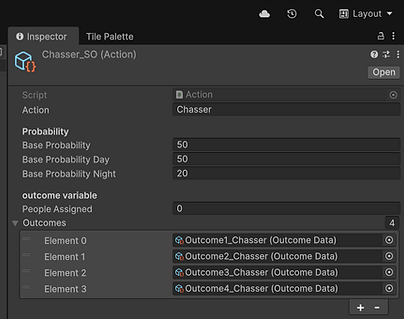
Each turn, the player can assign members of his cult to perform certain actions. Each action is a scriptable object storing base values such as the action's possible outcomes or the action's success probability. Using Scriptable objects helped us test and iterate throughout the project, in order to balance the game. Changing the scriptable object's values from within the engine was a significant time-saver.
Day/Night cycle and probabilities
At the end of a turn, the system calculates the final probability of an action succeeding and picks an outcome from a list of four : great success, success, great failure and failure. The calculation uses a parabola equation that takes into account : the action's base success probability depending on the turn type (night or day) and calculates the bonus given by the number of people assigned to the action.

The calculation of the final probability :
Action's base success probability
X
(
Number of people assigned
X
( 21 - number of people assigned )
2
)
final probability =
Player diary and daily events
When the player ends his turn and a new one starts, a random daily event is triggered which may or may not benefit the player. The diary menu opens up automatically at the beginning of a turn : this menu is designed to give the player feedback on the outcomes of his actions and the daily events that have happened.
